Slab
Why bring-your-own-AI beats a chatbot in every app
15 August 2026
Open five apps today and you'll meet five chatbots. Each wants its own subscription, each has its own model, and each keeps what you told it in its own silo. This is the scattered-AI problem, and it's getting worse. Slab is built on the opposite architecture.
The scattered-AI problem
The pattern is everywhere: a product bolts on “AI features” by wiring in a vendor's API, marking up the cost, and shipping a chat sidebar. Multiply that across your editor, your reading app, your notes app and your email client, and you get:
- Subscription stacking. You pay for Claude or ChatGPT — and then pay again for a diluted model inside every tool.
- Context silos. The insight you worked out with one app's chatbot doesn't exist anywhere else. Your thinking ends up scattered across a dozen chat histories owned by a dozen companies.
- Someone else's model. The app picked its AI vendor, its model tier, and its prompts. When a better model ships, you wait for them.
- Your documents in their pipeline. Every bolted-on chatbot means your content flowing through another company's AI agreement — one you never read.
The inversion
Bring-your-own-AI flips the direction of the connection. Instead of the app shipping an AI and sending your content out to it, your assistant connects in — to the tool, over MCP, the open standard AI assistants use to reach the outside world. The app stops being a chatbot vendor and becomes something better: a place your AI can work.
What falls out of that one decision:
- One assistant, everywhere. The same Claude, ChatGPT or Perplexity account — with its memory, its chat history, its projects and the credits you already pay for — works across your tools. Ask it something in any chat, and it can act on your documents.
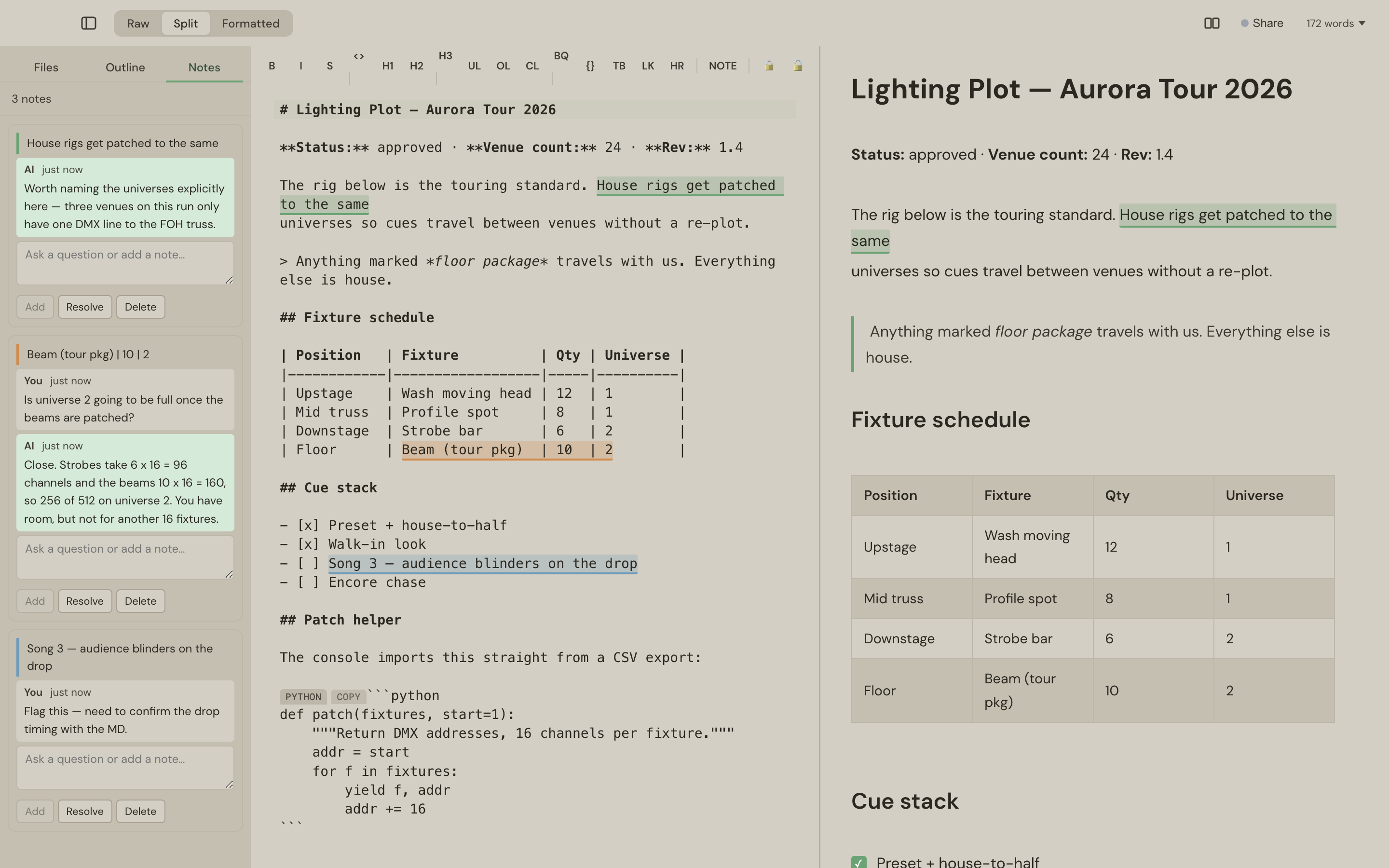
- Answers live with the work. In Slab the AI replies land in the margin of the document, threaded under your highlights — not in a chat window that evaporates. Come back next month and the reasoning is still attached to the sentence it was about.
- Always your best model. The day your provider ships a better model, your tools got smarter. No waiting for an app vendor to upgrade their integration.
- A privacy story you can actually verify. We never hold your AI credentials and never send your content to any AI provider. What your assistant reads is governed by the agreement you already have with it — no second company in the middle.
How Slab implements it
Slab Pad (Mac) runs the MCP server locally — loopback only, token-protected. Your assistant reads your selection, answers in margin threads, edits in place, opens drafts as tabs. Nothing is uploaded, ever; if you never connect an AI it's simply a fast, quiet Markdown editor.
Slab Reader (iPad) runs the connection in the cloud so your assistant can reach your library from any chat — via OAuth 2.1, with a labelled, revocable key per assistant. It reads your pencil highlights, replies under them, and can send you new reading.
Both take about two minutes to connect — the guide is here.
The honest trade-off
BYOAI assumes you have an AI subscription. If you don't, both Slab apps are complete products without one — but the loop is the point, and the loop needs an assistant. We think that's the right bet: the assistant subscription is fast becoming the one subscription knowledge workers actually keep. The tools around it shouldn't each demand their own.
See what the loop feels like — on the Mac today, on iPad soon.